The $100K Case: A Data-Driven Push to Move Legacy Apps to
a Component Library.
Problem Statement
The T-Mobile call center platform, Atlas, is not a single application but a collection of 40+ microapps built over time by different teams. Older apps use flat code, some only reference the design system’s CSS, while only the newest apps utilize the system’s Angular modular code library.
This fragmentation created inconsistencies, accessibility gaps, and bloated code. The result was slower load times, higher error rates, and costly maintenance.
High Level Steps
While broad evangelization had ensured new apps adopted the Frontline Design System’s code library, product teams struggled to prioritize modernizing older ones. Leadership supported the effort but preferred team autonomy, so an enterprise mandate was unlikely.
When I became Manager of the Frontline Design System (FUSE), I set out to break the stalemate. I led a cross-functional design system team of 12 direct reports: 2 Product Managers, 3 Designers, 5 Engineers, a Scrum master, and a Principal Researcher. We shifted to a data driven strategy to identify the apps with the highest impact and show product teams the time savings, ROI, and UX improvements modernization could deliver.
-
Prioritize Focus
With limited resources, my first task was to find out which applications would deliver the greatest impact on users and budget if updated.
-
Call Handling Costs
With no metrics, I reached out to the network to uncover the scale of care costs and how UX inefficiencies contributed.
-
Maintenance costs
I also investigated another angle, the cost to maintain flat html microapps vs ones using modularized components.
-
Drive Change
Work 1:1 with product teams to reveal the user and budget costs of staying on legacy code vs updating and offer our team’s capacity.
Prioritize Focus
With limited resources, I focused the team on the applications that would deliver the greatest impact for both users and T-Mobile’s budget. We looked for the intersection of highest usage and most problematic UX.
Atlas had no built in analytics, so we had to get creative. I partnered with the Frontline Experience Team (FSE) to access documentation on the top call reasons. I asked our researcher to shadow care experts as they handled those calls and track which microapps they used and what issues came up.
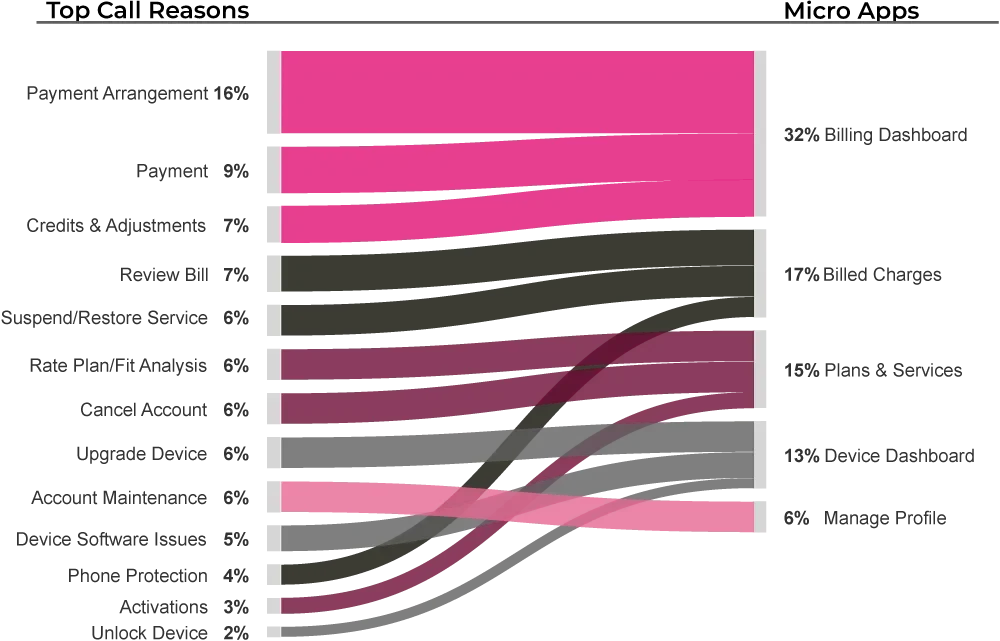
Next, I conducted a visual audit of the apps that appeared most often in calls. I looked for style guide violations, accessibility issues, and UI inconsistencies, which were strong indicators the apps were not built with the design system’s code library. To confirm, I asked my leads to survey lead engineers to hear from them about design system usage (CSS only, library, both, or neither). This information had never been tracked before.
Through this process, we narrowed the list to five high-usage microapps with significant UX and technical debt to prioritize for modernization.
Quantifying Call Costs
UX improvements are often overlooked without clear data, so I focused on modeling how inefficiencies in the Atlas interface increased call handling time and the operational cost of running T-Mobile’s call centers. Since Atlas had no analytics, I worked with our researchers to estimate time delays and error rates caused by legacy UI patterns using internal studies and industry benchmarks.
Once we had rough time estimates, I reconnected with FSE partners to gather operational data such as the total number of call center experts, average daily calls, and cost per minute of call time. From there we modeled the cost impact of UX inefficiencies across the platform.
Maintenance Cost
I also wanted product teams to see the engineering capacity cost of maintaining outdated apps. Two developers on our team who had previously worked on product teams shared comparisons of development time before and after adopting the system’s modular, auto-updating components. Our researcher validated those findings with additional developers across product teams. The sample was small and self-reported, but it provided a credible baseline that showed clear efficiency and maintenance savings.
Drive Change
I partnered with the team’s Senior Product Manager to present tailored, data driven findings to the Product Managers, Product Owners, and Lead Developers responsible for the highest impact Atlas microapps.
These sessions showed:
How their app fit into the full call workflow.
UX and accessibility gaps and the call costs tied to them.
Issues that would be solved by adopting modular components.
Expected build and maintenance savings.
Many teams were surprised to see how their apps fit into the broader workflow since most had only viewed their work in isolation. The main barrier was not willingness but capacity. Teams understood the long term value, but carving out roadmap time to refactor legacy code felt impossible while shipping new features.
To address this, I proposed a partnership model. Our design system developers would handle the modernization work while product teams provided onboarding and regression testing. This removed a major blocker and made modernization feasible.
Outcome
Within one year:
2 of 5 targeted apps modernized with modularized components.
$42K annual savings in engineering maintenance capacity.
Improved UX and accessibility for 32% of Atlas call center interactions.
The remaining three apps were added to the following year's roadmap, representing over $100K in annual maintenance savings in addition to call center efficiency improvements.
This project reinforced that design system adoption is often a prioritization challenge rather than a matter of desire. Translating downstream data into tangible business impact helped product teams see modernization as a clear opportunity worth prioritizing, even without direct analytics. This data-driven approach became a repeatable model for future modernization efforts across the platform.
Reflection
While built-in user tracking would have made the analysis faster, taking the time to trace the information and analyze downstream data gave clear cost and efficiency gains. That turned into a compelling business case for modernizing the micro-apps. It also reinforced that in a large organization, it’s easy to default to casting a wide advocacy net but targeting high-impact product teams with data-driven evidence tailored to the areas they owned would have driven change faster.
“Under their leadership, our design system matured
significantly—optimizing workflows for designers and developers, enhancing accessibility, and improving the
overall user experience.”
— Rina Yang, Project Manager